Strategic Branding in the Age of Generative AI
Artificial intelligence is changing how businesses approach branding, marketing, design, and customer communication. From generating creative concepts to developing messaging ideas, AI can help teams work more efficiently and explore new possibilities.
However, efficiency alone does not create a strong brand.
When businesses rely too heavily on generic AI-generated content, they risk losing the personality, originality, and consistency that help customers recognize and trust them.
The solution is not to avoid AI. It is to use it strategically while keeping your brand identity at the centre of every decision.
In this guide, we explore how businesses can integrate AI into their branding process without compromising their unique identity.
Brand identity is the collection of visual and verbal elements that communicate what a business represents. It includes your logo, typography, colours, messaging, tone of voice, positioning, and the overall experience you create for your audience. AI can help generate ideas for these elements, but it cannot automatically determine what makes your business meaningfully different. A distinctive brand requires a clear understanding of your audience, market, values, and competitive advantage. AI should support that understanding rather than replace it.

What Is Brand Identity in the Age of AI?
Brand identity is the collection of visual and verbal elements that communicate what a business represents.
It includes your logo, typography, colours, messaging, tone of voice, positioning, and the overall experience you create for your audience.
AI can help generate ideas for these elements, but it cannot automatically determine what makes your business meaningfully different.
A distinctive brand requires a clear understanding of your audience, market, values, and competitive advantage.
AI should support that understanding rather than replace it.
Use AI to Explore Brand Positioning
Brand positioning defines how you want customers to perceive your business compared with alternatives.
AI can help teams explore positioning statements, summarize customer feedback, organize competitor research, and generate alternative ways to communicate their value.
For example, a website development company might explore whether its messaging should emphasize technical expertise, conversion-focused experiences, speed, or long-term business growth.
These options provide a starting point for discussion.
Your team must then validate the ideas against actual customer needs and the services you can deliver.
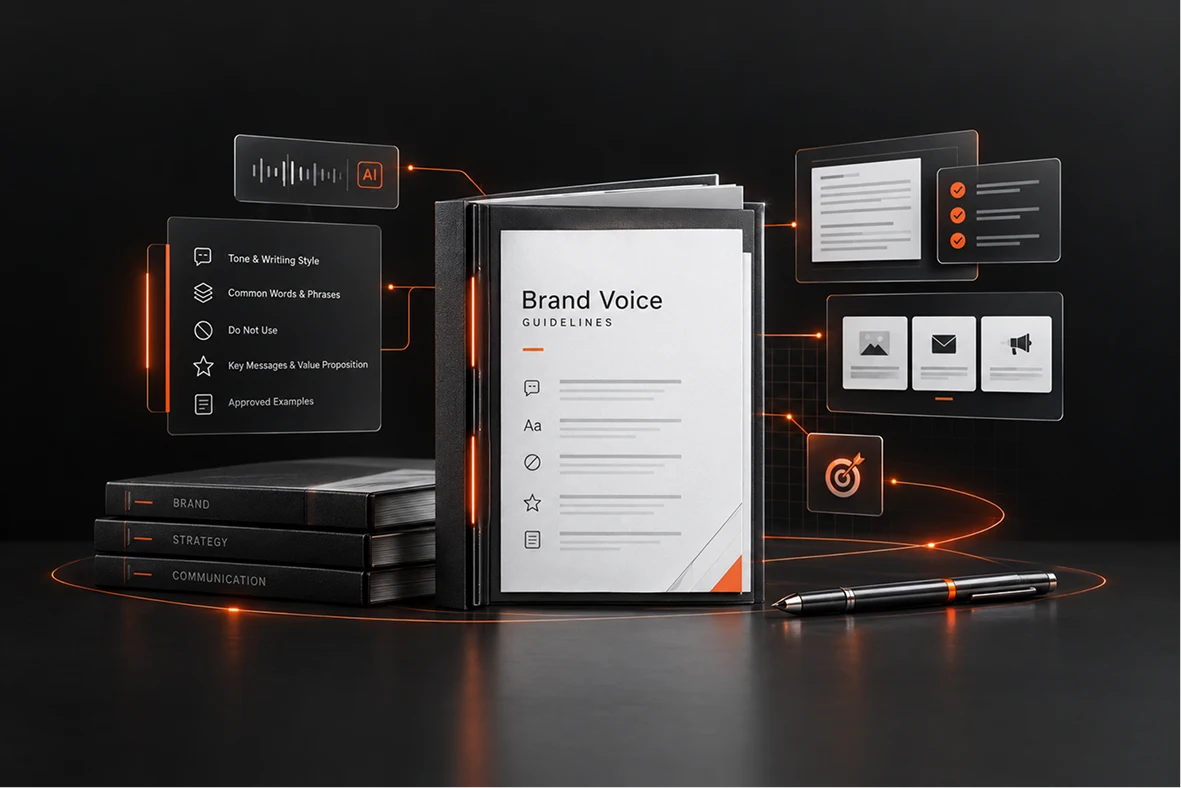
Develop a Consistent Brand Voice With AI
A recognizable brand sounds consistent across its website, social media, emails, advertisements, and other communication channels.
AI can help maintain that consistency when it has clear guidance.
Create a brand voice document that defines:
- Your preferred tone and writing style.
- Words and phrases your brand commonly uses.
- Language that does not fit your identity.
- Your key messages and value proposition.
- Examples of approved communication.
You may try these guidelines when generating drafts, but review every important piece of content before publication.
Consistency comes from a shared strategy and editorial process, not simply from using the same AI tool.
Use AI in Visual Branding Without Becoming Generic
AI-powered creative tools can help explore logo concepts, visual references, campaign imagery, colour directions, and moodboards.
However, an attractive generated image is not necessarily a usable brand asset.
A professional visual identity needs consistency, legibility, scalability, and a coherent design system.
Use AI to explore possibilities, then apply human art direction to establish the final design.
Review typography, spacing, colour relationships, accessibility, image rights, and how the identity performs across different applications.
Your brand should remain recognizable whether someone encounters it on a website, social media post, presentation, or advertisement.
Personalize Marketing While Protecting Customer Trust
AI can support the adaptation of marketing messages for different audience segments.
For example, a business may communicate differently with first-time visitors, existing customers, and people exploring a particular service.
However, personalization must be relevant and responsible.
Use appropriate data, respect customer privacy, and avoid making assumptions about individuals based on unreliable information.
Personalized communication should help customers find what they need rather than make them feel monitored or manipulated.
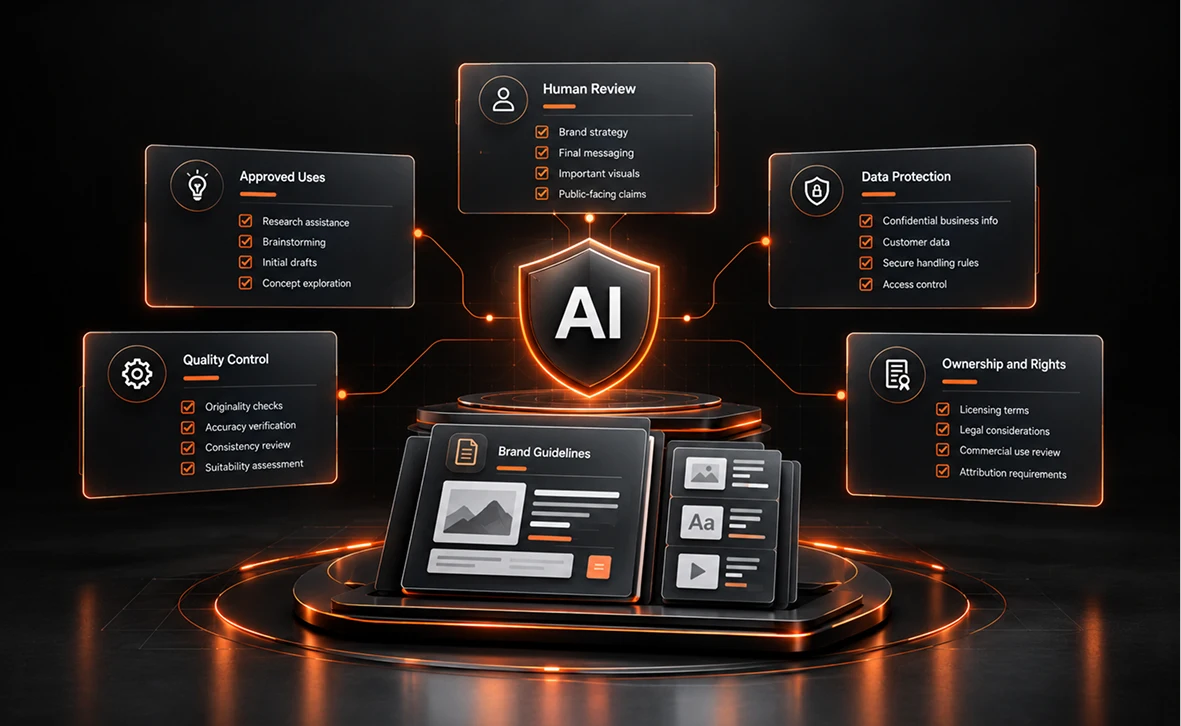
Establish Clear Rules for AI-Assisted Branding
Businesses should document how AI can be used within their creative workflows.
A practical framework includes:
Common Mistakes to Avoid
Businesses should avoid publishing unreviewed AI-generated content, copying generic visual concepts, relying on unsupported market assumptions, and allowing different teams to create conflicting brand messages.
Another mistake is measuring success only by how quickly content is produced.
A stronger brand is built by creating communication that customers understand, remember, and trust.
Conclusion
AI can help businesses explore ideas, organize information, and accelerate parts of the branding process. But a distinctive brand still requires strategic thinking, creative direction, and a deep understanding of the people it serves.
The objective is not to make your brand look more like AI.
It is to use technology to express what makes your business different more clearly and consistently.
Build a brand with strategy, creativity, and purpose.
At BranStr, we help businesses develop distinctive brand identities and digital experiences that support their long-term goals.
Ready to build a stronger brand? Get in touch with BranStr to discuss your branding and digital growth needs.