

AI and Human Web Development
Website development is evolving as artificial intelligence becomes part of the design, coding, testing, and content creation process.
What Is AI-Assisted Website Development?
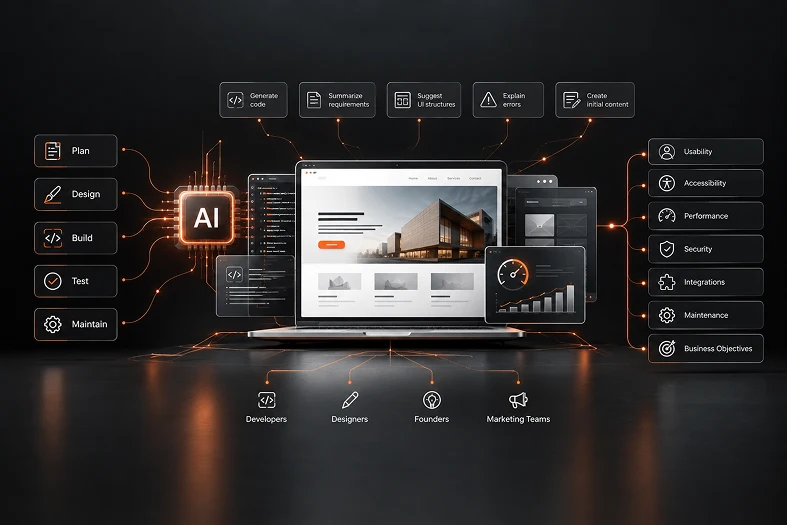
AI-assisted website development uses AI tools to support activities involved in planning, designing, building, testing, and maintaining websites.
AI Can Help Accelerate Website Planning
The planning stage defines the website's purpose and structure. AI can assist with organizing requirements, generating sitemap ideas, identifying possible user journeys, and preparing initial page outlines.
- A homepage explaining its value proposition.
- Service pages describing specific offerings.
- A portfolio or case studies section.
- An about page that establishes credibility.
- A blog or resource centre.
- Contact forms and enquiry pathways.AI can help develop an initial structure, but the final sitemap should reflect actual customer needs and the business's priorities.
Use AI to Support UI/UX Design
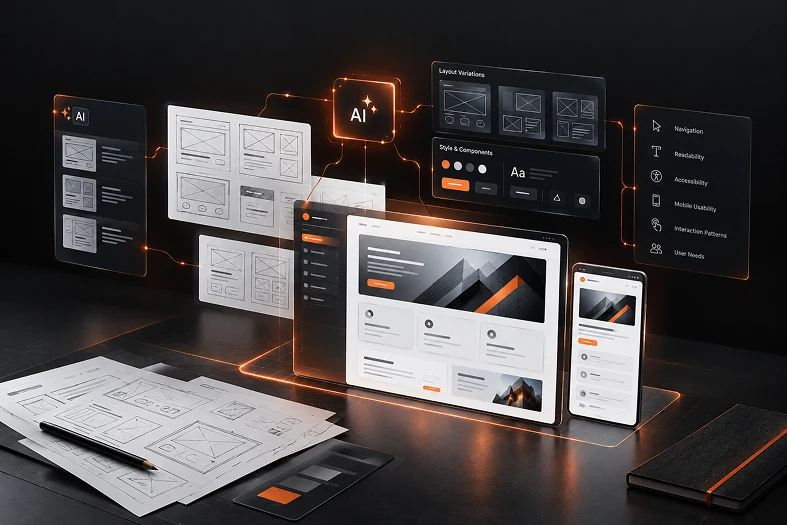
AI tools can help explore interface concepts, suggest layout variations, and generate early wireframe ideas.
AI Can Assist With Coding and Debugging
AI coding assistants can help developers understand unfamiliar code, draft routine functions, generate examples, and investigate possible causes of errors.
Improve Website Content Creation
AI can help prepare initial drafts for homepage messaging, service descriptions, frequently asked questions, blog outlines, and other website content.
AI Website Builders vs. Custom Development
AI-assisted website builders and custom development serve different needs. Neither approach is universally better. The right choice depends on project requirements, budget, expected growth, and ongoing maintenance needs.
- AI website builders: These may suit simple websites, early-stage experiments, landing pages, or businesses that need to establish a basic online presence quickly. Their suitability depends on the available templates, customization, integrations, hosting arrangements, and platform limitations.
- Custom website development: Custom development may be more appropriate when a business needs specialized functionality, complex integrations, tailored user journeys, or greater control over the implementation. It may also require a larger investment of time and resources.Neither approach is universally better. The right choice depends on project requirements, budget, expected growth, and ongoing maintenance needs.
Keep Performance, Accessibility, and Security in Focus
A website should work reliably for the people who use it.
- Mobile responsiveness.
- Page loading performance.
- Keyboard navigation and accessibility.
- Forms and interactive elements.
- Browser compatibility.
- Security and data handling.
- Analytics and conversion tracking.
- Backup and maintenance processes.
A Practical AI-Assisted Website Development Workflow
A balanced process can include these stages:
- Discover: Define business goals, audience needs, functionality, and technical constraints.
- Plan: Establish the sitemap, content requirements, and user journeys.
- Design: Develop and review interface concepts against the project brief.
- Build: Use appropriate development tools, including AI assistance where useful.
- Test: Validate usability, performance, accessibility, functionality, and security.
- Launch and improve: Monitor real usage, fix issues, and refine the experience over time.The most important principle is to maintain accountability at every stage.
Conclusion
AI is creating new opportunities to improve website planning, design exploration, coding assistance, and content production.